


News Center
Home > News Center
新闻动态
NEWS CENTER

Service phone:
0513-82110880
Address:
No. 8 Donghai East Road, Haimen District, Nantong City, Jiangsu Province
Pros and cons of using a capacitor withstand voltage tester for testing capacitors
Author:Haimen Sancon Electronics Co.Ltd
Click:
A capacitor withstand voltage tester (also called a hipot tester or dielectric strength tester) is often used by many customers to judge the quality of capacitors when they don't have professional equipment. It can indeed help determine the material limits of the capacitor and whether the product is functioning properly when the budget is tight, but the way the test conditions are set has a significant impact on the assessment of the capacitor.
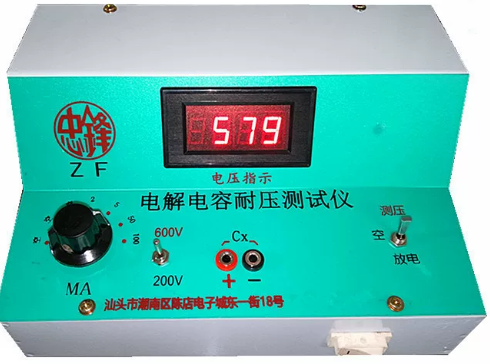
The general circuit structure is as follows:

The device is a simple high-voltage multiplier power supply, with a fixed voltage. It relies entirely on switchable current-limiting resistors and automatic voltage division at full current to determine the actual voltage across the capacitors. The problem with this testing method is that it can put too much stress on the capacitors, and if the current is set too high, there's a risk of premature breakdown, which can lead to inaccurate tests or misjudgments. The proper way to test is to use a leakage current tester or an aluminum foil TV tester, which is more accurate and professional.

Advantages:
1. Can directly test insulation performance
By applying a DC voltage higher than the rated value, you can directly check whether the capacitor’s insulating material can withstand the designed voltage. This is something a regular multimeter can’t do. It can detect potential insulation issues (like aging of the dielectric, internal microcracks, or moisture), which might not show up under low voltage.
2. High testing efficiency and clear results
The test usually only takes a few seconds to tens of seconds, with a clear pass/fail result (breakdown or excessive leakage current means it’s bad). It’s suitable for batch screening and is widely used on production lines.
Disadvantages:
1. It's a destructive/damaging test
The test involves applying overvoltage (usually 1.5–2 times the rated voltage). Even if the capacitor passes, this can still stress the dielectric and potentially shorten its lifespan. Once it breaks down, the capacitor is completely ruined and can't be fixed.
2. Can't fully determine the capacitor's condition
It only checks voltage tolerance and insulation, and can't detect key parameters like capacitance deviation, ESR (equivalent series resistance), or dissipation factor (tanδ). For example, a capacitor that has significantly lost capacitance but still has good insulation would pass a voltage test, but it wouldn't actually work properly in a circuit.
3. Sensitive to Test Conditions
Test results are heavily influenced by voltage rise rate, duration, and environmental temperature and humidity. Improper operation can lead to misjudgments. Electrolytic capacitors are polarized, and reversing them can cause immediate breakdown, so there’s some risk in handling them.
4. Safety Risks
Testing involves high voltage (hundreds to thousands of volts), which poses an electric shock hazard, requiring professional protection. Capacitor breakdown can lead to splashing, smoke, or even explosions.
5. Not Suitable for Online Testing
Capacitors usually need to be removed from the circuit board for individual testing, making in-circuit checking inconvenient and troubleshooting less handy.

3. Summary: Since the device can't set the voltage, it can only slowly raise it using current limiting. During testing, the current needs to be kept low; too high a current can easily damage the capacitor. The actual test voltage will eventually get close to the real voltage tolerance of the aluminum foil, but because of the capacitor's design, the test can exceed its actual tolerance, making breakdown or damage quite likely. This doesn’t mean the capacitor is bad, it’s just that the test voltage is too high. So, this instrument can give a rough idea of the aluminum foil's limit, but it’s prone to misjudgment. In real use, you need more tests to actually determine if the capacitor is okay.

点击右上角
分享给朋友吧







 Long by picture save/share
0

Nantong Sanxin Electronics Co., Ltd. is a professional factory that integrates the research and development, production, and sales of aluminum electrolytic capacitors.
点击右上角
分享给朋友吧
Products and Services
Contact Us
Address: No. 8 Donghai East Road, Haimen District, Nantong City, Jiangsu Province
Phone:0513-82110880
Email:sales@sancon.com.cn
Copyright © 2023 Nantong Sanxin Electronics Technology Co., Ltd. All Rights Reserved 苏ICP备11035887号 Technical Support: Suyuan Network
Copyright © 2023 南通三鑫电子科技股份有限公司 All Rights Reserved 苏ICP备11035887号 技术支持:速远网络

